Successor site to the Philosophy of Happiness blog (http://philoshap.blogspot.com/) that supported PHIL 3160 at MTSU, 2011-2019. The course returns Fall 2025.
PHIL 3160 – Philosophy of Happiness
Up@dawn 2.0
Monday, September 8, 2025
Keeping a good milieu
Saturday, September 6, 2025
Epicurus: we don’t need to chase so hard after unimportant things
If we think more wealth, fame, or power is the answer, for instance, we must recognize that, no matter how much we obtain of these things, it's always possible to get more.
Satisfying such desires is thus impossible, so we shouldn't waste our lives anxiously in thrall to them.
As he puts it…
https://www.threads.com/@philosophybreak/post/DOOkwn_jE45?xmt=AQF0j_qNi9hCP7q7h6taU_JSIIEeTnKROKfeX-iBHTe_2g&slof=1
Meaningfully happy
https://fivebooks.com/best-books/paul-thagard-meaning-of-life/
Friday, September 5, 2025
Questions Sep 9
Haybron 7-8
1. More important than whether you're happy, says Haybron, is what?2. What makes civilization possible?
3. As a general rule, says Haybron, selfish and shallow people don't look _____.
4. A more demanding notion of the good life must meet what standard?
5. Does Haybron recommend scheduling quality family time?
6. What does Kahneman say about "focusing illusions"?
DQ:
- It's easy to say that someone else's happiness is not the most important thing, harder to say that of yourself. Do you?
- Do you share the consensus of "virtually all ethical philosophers" that "acting badly is out of the question, even if that would make us happier"? What compels this view?
- Comment: "One should not be an asshole in the pursuit of happiness."
- Will having kids make you happier? Better? 97-8
- What "model of appreciative engagement" in music or another art do you prefer? 100
- Have you encountered "touroids"? 104 Did you ignore them, taunt them, take their picture...? Are they despicable, or merely laughable?
- Have you known a "Dr. Tom"?
- What percentage of your friends and acquaintances pass the "eulogy test"? 111
- No old person lies on his deathbed and regrets not having ended it as a teenager. 113 True?
- Would you prefer that your children lead extraordinary public lives, or lives that are serene, wise, and anonymous? How do you defend your preference? 115
- Are you addicted to a device or a social medium? Does this concern you? How will you redress it? 117k
- Comment: is figure 16 disturbing? Have you been in this scenario? Will you be, in the future? Do you accept this as normal and acceptable in today's world?
- To what grandmotherly wisdom do you subscribe? Or do you think older people have nothing relevant to teach?
- More discussion questions in comments?
The Myth of Quality Time
EVERY summer for many years now, my family has kept to our ritual. All 20 of us — my siblings, my dad, our better halves, my nieces and nephews — find a beach house big enough to fit the whole unruly clan. We journey to it from our different states and time zones. We tensely divvy up the bedrooms, trying to remember who fared poorly or well on the previous trip. And we fling ourselves at one another for seven days and seven nights.
That’s right: a solid week. It’s that part of the ritual that mystifies many of my friends, who endorse family closeness but think that there can be entirely too much of it. Wouldn’t a long weekend suffice? And wouldn’t it ward off a few spats and simplify the planning?
The answer to the second question is yes, but to the first, an emphatic no.
I used to think that shorter would be better, and in the past, I arrived for these beach vacations a day late or fled two days early, telling myself that I had to when in truth I also wanted to — because I crave my space and my quiet, and because I weary of marinating in sunscreen and discovering sand in strange places. But in recent years, I’ve showed up at the start and stayed for the duration, and I’ve noticed a difference.
With a more expansive stretch, there’s a better chance that I’ll be around at the precise, random moment when one of my nephews drops his guard and solicits my advice about something private. Or when one of my nieces will need someone other than her parents to tell her that she’s smart and beautiful. Or when one of my siblings will flash back on an incident from our childhood that makes us laugh uncontrollably, and suddenly the cozy, happy chain of our love is cinched that much tighter.
There’s simply no real substitute for physical presence. We delude ourselves when we say otherwise, when we invoke and venerate “quality time,” a shopworn phrase with a debatable promise: that we can plan instances of extraordinary candor, plot episodes of exquisite tenderness, engineer intimacy in an appointed hour.
We can try. We can cordon off one meal each day or two afternoons each week and weed them of distractions. We can choose a setting that encourages relaxation and uplift. We can fill it with totems and frippery — a balloon for a child, sparkling wine for a spouse — that signal celebration and create a sense of the sacred.
And there’s no doubt that the degree of attentiveness that we bring to an occasion ennobles or demeans it. Better to spend 15 focused, responsive minutes than 30 utterly distracted ones.
But people tend not to operate on cue. At least our moods and emotions don’t. We reach out for help at odd points; we bloom at unpredictable ones. The surest way to see the brightest colors, or the darkest ones, is to be watching and waiting and ready for them.
That’s reflected in a development that Claire Cain Miller and David Streitfeld wrote about in The Times last week. They noted that “a workplace culture that urges new mothers and fathers to hurry back to their cubicles is beginning to shift,” and they cited “more family-friendly policies” at Microsoft and Netflix, which have extended the leave that parents can take.
They’ll be lucky: Many people aren’t privileged enough to exercise such discretion. My family is lucky, too. We have the means to get away.
But we’re also dedicated to it, and we’ve determined that Thanksgiving Day isn’t ample, that Christmas Eve passes too quickly, and that if each of us really means to be central in the others’ lives, we must make an investment, the biggest components of which are minutes, hours, days. As soon as our beach week this summer was done, we huddled over our calendars and traded scores of emails to figure out which week next summer we could all set aside. It wasn’t easy. But it was essential.
Couples move in together not just because it’s economically prudent. They understand, consciously or instinctively, that sustained proximity is the best route to the soul of someone; that unscripted gestures at unexpected junctures yield sweeter rewards than scripted ones on date night; that the “I love you” that counts most isn’t whispered with great ceremony on a hilltop in Tuscany. No, it slips out casually, spontaneously, in the produce section or over the dishes, amid the drudgery and detritus of their routines. That’s also when the truest confessions are made, when hurt is at its rawest and tenderness at its purest.
I know how my 80-year-old father feels about dying, religion and God not because I scheduled a discrete encounter to discuss all of that with him. I know because I happened to be in the passenger seat of his car when such thoughts were on his mind and when, for whatever unforeseeable reason, he felt comfortable articulating them.
And I know what he appreciates and regrets most about his past because I was not only punctual for this summer’s vacation, but also traveled there with him, to fatten our visit, and he was uncharacteristically ruminative on that flight.
It was over lunch at the beach house one day that my oldest nephew spoke with unusual candor, and at unusual length, about his expectations for college, his experiences in high school — stuff that I’d grilled him about previously, never harvesting the generous answers that he volunteered during that particular meal.
It was on a run the next morning that my oldest niece described, as she’d never done for me before, the joys, frustrations and contours of her relationships with her parents, her two sisters and her brother. Why this information tumbled out of her then, with pelicans overhead and sweat slicking our foreheads, I can’t tell you. But I can tell you that I’m even more tightly bonded with her now, and that’s not because of some orchestrated, contrived effort to plumb her emotions. It’s because I was present. It’s because I was there. --Frank Bruni, nyt
==
How to Live Wisely.
Imagine you are Dean for a Day. What is one actionable change you would implement to enhance the college experience on campus?
I have asked students this question for years. The answers can be eye-opening. A few years ago, the responses began to move away from “tweak the history course” or “change the ways labs are structured.” A different commentary, about learning to live wisely, has emerged.
What does it mean to live a good life? What about a productive life? How about a happy life? How might I think about these ideas if the answers conflict with one another? And how do I use my time here at college to build on the answers to these tough questions? (nyt - continues)==
The Meaning of Life, the secret of happiness
"Well, it's nothing very special. Uh, try and be nice to people, avoid eating fat, read a good book every now and then, get some walking in, and try and live together in peace and harmony with people of all creeds and nations..."
- Monty Python
"A life that partakes even a little of friendship, love, irony, humor, parenthood, literature, and music, and the chance to take part in battles for the liberation of others cannot be called 'meaningless' except if the person living it is also an existentialist and elects to call it so. It could be that all existence is a pointless joke, but it is not in fact possible to live one's everyday life as if this were so." Christopher Hitchens
“The literal meaning of life is whatever you're doing that prevents you from killing yourself.” Albert Camus
“A life of short duration...could be so rich in joy and love that it could contain more meaning than a life lasting eighty years... Those who have a 'why' to live, can bear with almost any 'how'.” Viktor E. Frankl
==
Old Podcast ch7 ... Happiness & the good life
Serene and high-spirited
- Ralph Waldo Emerson
Thursday, September 4, 2025
Good people are happier
https://www.psychologytoday.com/us/blog/modern-minds/202505/good-people-are-happier-and-this-is-why
Wednesday, September 3, 2025
The guy who ran off with Scarlett Johansson (in Her)
“We are living in a culture entirely hypnotized by the illusion of time, in which the so-called present moment is felt as nothing but an infintesimal hairline between an all-powerfully causative past and an absorbingly important future. We have no present. Our consciousness is almost completely preoccupied with memory and expectation. We do not realize that there never was, is, nor will be any other experience than present experience. We are therefore out of touch with reality. We confuse the world as talked about, described, and measured with the world which actually is. We are sick with a fascination for the useful tools of names and numbers, of symbols, signs, conceptions and ideas.”― Alan Wilson Watts
“Tomorrow and plans for tomorrow can have no significance at all unless you are in full contact with the reality of the present, since it is in the present and only in the present that you live. There is no other reality than present reality, so that, even if one were to live for endless ages, to live for the future would be to miss the point everlastingly.”
― The Wisdom of Insecurity: A Message for an Age of Anxiety
William James on happiness
"I think that yesterday was a crisis in my life. I finished the first part of Renouvier's second "Essais" and see no reason why his definition of Free Will—"the sustaining of a thought because I choose to when I might have other thoughts"—need be the definition of an illusion. At any rate, I will assume for the present—until next year—that it is no illusion. My first act of free will shall be to believe in free will. For the remainder of the year, I will abstain from the mere speculation and contemplative Grüblei[48] in which my nature takes most delight, and voluntarily cultivate the feeling of moral freedom, by reading books favorable to it, as well as by acting. After the first of January, my callow skin being somewhat fledged, I may perhaps return to metaphysical study and skepticism without danger to my powers of action. For the present then remember: care little for speculation; much for the form of my action; recollect that only when habits of order are formed can we advance to really interesting fields of action—and consequently accumulate grain on grain of willful choice like a very miser; never forgetting how one link dropped undoes an indefinite number. Principiis obsta—Today has furnished the exceptionally passionate initiative which Bain posits as needful for the acquisition of habits. I will see to the sequel. Not in maxims, not in Anschauungen,[49] but in accumulated acts of thought lies salvation. Passer outre. Hitherto, when I have felt like taking a free initiative, like daring to act originally, without carefully waiting for contemplation of the external world to determine all for me, suicide seemed the most manly form to put my daring into; now, I will go a step further with my will, not only act with it, but believe as well; believe in my individual reality and creative power. My belief, to be sure, can't be optimistic—but I will posit life (the real, the good) in the self-governing resistance of the ego to the world. Life shall [be built in][50] doing and suffering and creating." Diary-April 30, 1870
==
What is the task which philosophers set themselves to perform; and why do they philosophize at all? Almost every one will immediately reply: They desire to attain a conception of the frame of things which shall on the whole be more rational than that somewhat chaotic view which every one by nature carries about with him under his hat. But suppose this rational conception attained, how is the philosopher to recognize it for what it is, and not let it slip through ignorance? The only answer can be that he will recognize its rationality as he recognizes everything else, by certain subjective marks with which it affects him. When he gets the marks, he may know that he has got the rationality.
What, then, are the marks? A strong feeling of ease, peace, rest, is one of them. The transition from a state of puzzle and perplexity to rational comprehension is full of lively relief and pleasure.
But this relief seems to be a negative rather than a positive character. Shall we then say that the feeling of rationality is constituted merely by the absence {64}of any feeling of irrationality? I think there are very good grounds for upholding such a view. All feeling whatever, in the light of certain recent psychological speculations, seems to depend for its physical condition not on simple discharge of nerve-currents, but on their discharge under arrest, impediment, or resistance. Just as we feel no particular pleasure when we breathe freely, but a very intense feeling of distress when the respiratory motions are prevented,—so any unobstructed tendency to action discharges itself without the production of much cogitative accompaniment, and any perfectly fluent course of thought awakens but little feeling; but when the movement is inhibited, or when the thought meets with difficulties, we experience distress. It is only when the distress is upon us that we can be said to strive, to crave, or to aspire. When enjoying plenary freedom either in the way of motion or of thought, we are in a sort of anaesthetic state in which we might say with Walt Whitman, if we cared to say anything about ourselves at such times, "I am sufficient as I am." This feeling of the sufficiency of the present moment, of its absoluteness,—this absence of all need to explain it, account for it, or justify it,—is what I call the Sentiment of Rationality. As soon, in short, as we are enabled from any cause whatever to think with perfect fluency, the thing we think of seems to us pro tanto rational.
Whatever modes of conceiving the cosmos facilitate this fluency, produce the sentiment of rationality. Conceived in such modes, being vouches for itself and needs no further philosophic formulation. But this fluency may be obtained in various ways; and first I will take up the theoretic way... (continues)
From
we have a right ever and anon to take a moral holiday, to let the world wag in its own way, feeling that its issues are in better hands than ours and are none of our business.
The universe is a system of which the individual members may relax their anxieties occasionally, in which the don't-care mood is also right for men, and moral holidays in order—that, if I mistake not, is part, at least, of what the Absolute is 'known-as,' that is the great difference in our particular experiences which his being true makes for us, that is part of his cash-value when he is pragmatically interpreted. Farther than that the ordinary lay-reader in philosophy who thinks favorably of absolute idealism does not venture to sharpen his conceptions. He can use the Absolute for so much, and so much is very precious. He is pained at hearing you speak incredulously of the Absolute, therefore, and disregards your criticisms because they deal with aspects of the conception that he fails to follow.
If the Absolute means this, and means no more than this, who can possibly deny the truth of it? To deny it would be to insist that men should never relax, and that holidays are never in order. I am well aware how odd it must seem to some of you to hear me say that an idea is 'true' so long as to believe it is profitable to our lives. That it is GOOD, for as much as it profits, you will gladly admit. If what we do by its aid is good, you will allow the idea itself to be good in so far forth, for we are the better for possessing it. But is it not a strange misuse of the word 'truth,' you will say, to call ideas also 'true' for this reason?
To answer this difficulty fully is impossible at this stage of my account. You touch here upon the very central point of Messrs. Schiller's, Dewey's and my own doctrine of truth, which I cannot discuss with detail until my sixth lecture. Let me now say only this, that truth is ONE SPECIES OF GOOD, and not, as is usually supposed, a category distinct from good, and co-ordinate with it. THE TRUE IS THE NAME OF WHATEVER PROVES ITSELF TO BE GOOD IN THE WAY OF BELIEF, AND GOOD, TOO, FOR DEFINITE, ASSIGNABLE REASONS. Surely you must admit this, that if there were NO good for life in true ideas, or if the knowledge of them were positively disadvantageous and false ideas the only useful ones, then the current notion that truth is divine and precious, and its pursuit a duty, could never have grown up or become a dogma. In a world like that, our duty would be to SHUN truth, rather. But in this world, just as certain foods are not only agreeable to our taste, but good for our teeth, our stomach and our tissues; so certain ideas are not only agreeable to think about, or agreeable as supporting other ideas that we are fond of, but they are also helpful in life's practical struggles. If there be any life that it is really better we should lead, and if there be any idea which, if believed in, would help us to lead that life, then it would be really BETTER FOR US to believe in that idea, UNLESS, INDEED, BELIEF IN IT INCIDENTALLY CLASHED WITH OTHER GREATER VITAL BENEFITS.
'What would be better for us to believe'! This sounds very like a definition of truth. It comes very near to saying 'what we OUGHT to believe': and in THAT definition none of you would find any oddity. Ought we ever not to believe what it is BETTER FOR US to believe? And can we then keep the notion of what is better for us, and what is true for us, permanently apart?
Pragmatism says no, and I fully agree with her. Probably you also agree, so far as the abstract statement goes, but with a suspicion that if we practically did believe everything that made for good in our own personal lives, we should be found indulging all kinds of fancies about this world's affairs, and all kinds of sentimental superstitions about a world hereafter. Your suspicion here is undoubtedly well founded, and it is evident that something happens when you pass from the abstract to the concrete, that complicates the situation.
I said just now that what is better for us to believe is true UNLESS THE BELIEF INCIDENTALLY CLASHES WITH SOME OTHER VITAL BENEFIT. Now in real life what vital benefits is any particular belief of ours most liable to clash with? What indeed except the vital benefits yielded by OTHER BELIEFS when these prove incompatible with the first ones? In other words, the greatest enemy of any one of our truths may be the rest of our truths. Truths have once for all this desperate instinct of self-preservation and of desire to extinguish whatever contradicts them. My belief in the Absolute, based on the good it does me, must run the gauntlet of all my other beliefs. Grant that it may be true in giving me a moral holiday. Nevertheless, as I conceive it,—and let me speak now confidentially, as it were, and merely in my own private person,—it clashes with other truths of mine whose benefits I hate to give up on its account. It happens to be associated with a kind of logic of which I am the enemy, I find that it entangles me in metaphysical paradoxes that are inacceptable, etc., etc.. But as I have enough trouble in life already without adding the trouble of carrying these intellectual inconsistencies, I personally just give up the Absolute. I just TAKE my moral holidays; or else as a professional philosopher, I try to justify them by some other principle.
If I could restrict my notion of the Absolute to its bare holiday-giving value, it wouldn't clash with my other truths. But we cannot easily thus restrict our hypotheses. They carry supernumerary features, and these it is that clash so. My disbelief in the Absolute means then disbelief in those other supernumerary features, for I fully believe in the legitimacy of taking moral holidays... (continues)
Our chief concern
If we were to ask the question: “What is human life's chief concern?” one of the answers we should receive would be: “It is happiness.” How to gain, how to keep, how to recover happiness, is in fact for most men at all times the secret motive of all they do, and of all they are willing to endure. William James
Penultimate happiness: "I can't stand it!"
To Henry Adams: ...Though the ultimate state of the universe may be its vital and psychical extinction, there is nothing in physics to interfere with the hypothesis that the PENultimate state might be the millennium-a state in which a minimum of difference of energy-level might have its exchanges so skillfully canalised that a maximum of happy and virtuous consciousness would be the only result. In short, the last expiring pulsation of the universe's life might be, "I AM SO HAPPY AND PERFECT THAT I CAN STAND IT NO LONGER!" William James, Letters June 1910 [he died in August]
Tuesday, September 2, 2025
Questions Sep 4
2. What do studies show about consumerist materialism and intrinsic motivation?
3. At what $ level do happiness and income "cease to show a pretty substantial link"?
4. What does an Aristotelian nature-fulfillment theory of happiness find objectionable about the experience machine scenario?
5. What do Desire theories have trouble explaining?
6. How might a philosophical theory of well-being settle the strivers vs. enjoyers debate?
Discussion Questions:
- Buddhists say desire and attachment are our great source of unhappiness. William James (see below $) says they're "imperative" and deserve to be fulfilled to the extent they can be, without shortchanging other worthy desires. What do you say?
- Aristotle said living well consists in doing something, over a lifetime, that actualizes the virtues of the rational part of the soul. Agree? What kinds of things do you think you must do, to be happy?
- Do you consider yourself genetically advantaged or disadvantaged, in the happiness sweepstakes?
- Is there anything on your Source List that Haybron omits to mention?
- Do you identify with the Epicureans, Stoics, or Buddhists in their emphasis on simplicity as prerequisite to happiness? 56 What aspects of your life have you simplified? What would you simplify if you could (but you can't)?
- Was your childhood "coddled" and "risk-free"? 58 How risk-averse are you now?
- Is happiness a choice, or isn't it? 59 If it's a "skill," how have you chosen to cultivate it? Can you fly as (relatively) imperturbably as Haybron? 61
- Can those of us who refuse to "accept things as they are" be as happy as those who do? 61
- Have you experienced great joy from volunteer & charity work?
- Do you ever feel chastened by the thought that, though you know you should be happy, you still bicker about petty things? 64
- Do you worry about becoming a "wage slave"? Since many of us must work for wages, how can you avoid that fate?
- How much of western unhappiness is a reflection of "option freedom"? 65-6
- How important to your happiness is "being in charge of your daily routines"? 67
- Do you have any use at all for an experience machine? 78
- Can you defend watching television and playing video games in a basement as other than rank pleasure-seeking fit only for dumb grazing animals? 80
- Can a Genghis Khan or a Hitler flourish and be happy? Why not? 85
- What do you think of Haybron's remarks on the treatment of animals? 89-90
- What do you think of the School of Life's "problem with our phones" and Franklin Foer's "existential threat"? (See # below)
- Post yours
Oliver said: “I’ve always wanted to write poems and nothing else. There were times over the years when life was not easy, but if you’re working a few hours a day and you’ve got a good book to read, and you can go outside to the beach and dig for clams, you’re okay.”
http://writersalmanac.org/
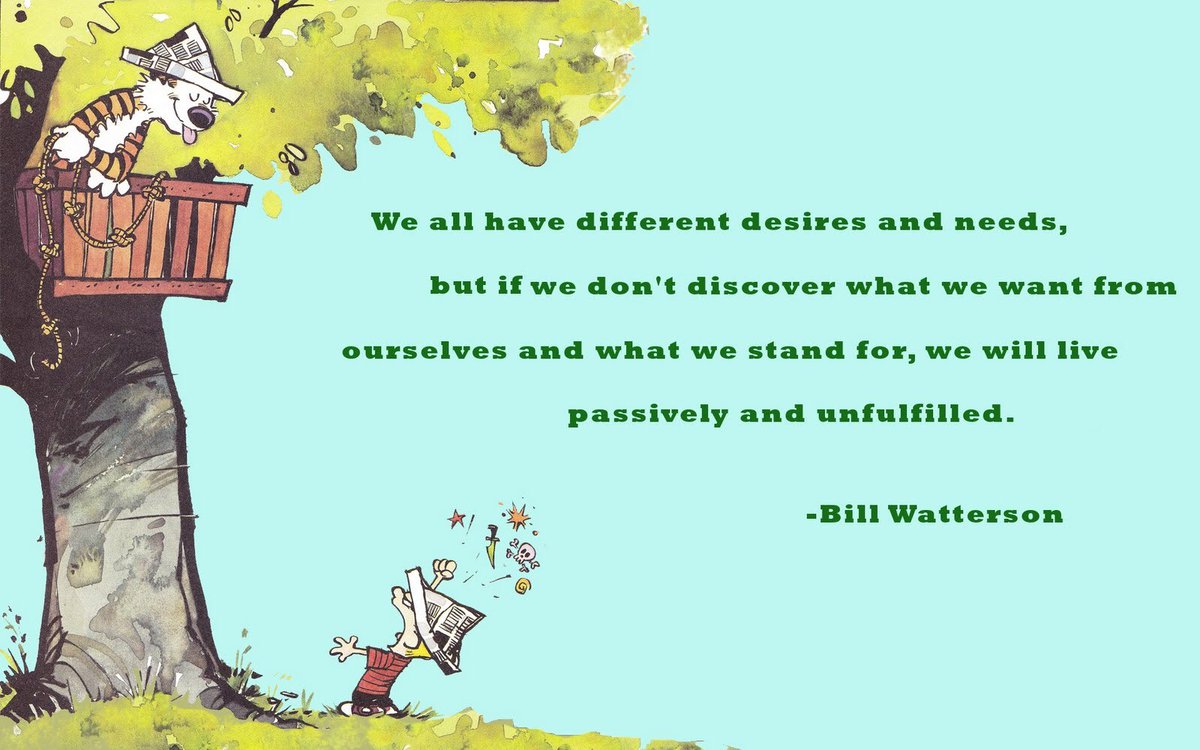
...and from Calvin & Hobbes

==
Cypher's choice in The Matrix
==
Aristotle & eudaimonia
The principal idea with which Aristotle begins is that there are differences of opinion about what is best for human beings, and that to profit from ethical inquiry we must resolve this disagreement. He insists that ethics is not a theoretical discipline: we are asking what the good for human beings is not simply because we want to have knowledge, but because we will be better able to achieve our good if we develop a fuller understanding of what it is to flourish. In raising this question—what is the good?—Aristotle is not looking for a list of items that are good. He assumes that such a list can be compiled rather easily; most would agree, for example, that it is good to have friends, to experience pleasure, to be healthy, to be honored, and to have such virtues as courage at least to some degree. The difficult and controversial question arises when we ask whether certain of these goods are more desirable than others. Aristotle's search for the good is a search for the highest good, and he assumes that the highest good, whatever it turns out to be, has three characteristics: it is desirable for itself, it is not desirable for the sake of some other good, and all other goods are desirable for its sake.Aristotle thinks everyone will agree that the terms “eudaimonia” (“happiness”) and “eu zên” (“living well”) designate such an end. The Greek term “eudaimon” is composed of two parts: “eu” means “well” and “daimon” means “divinity” or “spirit.” To be eudaimon is therefore to be living in a way that is well-favored by a god. But Aristotle never calls attention to this etymology in his ethical writings, and it seems to have little influence on his thinking. He regards “eudaimon” as a mere substitute for eu zên (“living well”). These terms play an evaluative role, and are not simply descriptions of someone's state of mind.
No one tries to live well for the sake of some further goal; rather, being eudaimon is the highest end, and all subordinate goals—health, wealth, and other such resources—are sought because they promote well-being, not because they are what well-being consists in. But unless we can determine which good or goods happiness consists in, it is of little use to acknowledge that it is the highest end. To resolve this issue, Aristotle asks what the ergon (“function,” “task,” “work”) of a human being is, and argues that it consists in activity of the rational part of the soul in accordance with virtue (1097b22–1098a20). One important component of this argument is expressed in terms of distinctions he makes in his psychological and biological works. The soul is analyzed into a connected series of capacities: the nutritive soul is responsible for growth and reproduction, the locomotive soul for motion, the perceptive soul for perception, and so on. The biological fact Aristotle makes use of is that human beings are the only species that has not only these lower capacities but a rational soul as well. The good of a human being must have something to do with being human; and what sets humanity off from other species, giving us the potential to live a better life, is our capacity to guide ourselves by using reason. If we use reason well, we live well as human beings; or, to be more precise, using reason well over the course of a full life is what happiness consists in. Doing anything well requires virtue or excellence, and therefore living well consists in activities caused by the rational soul in accordance with virtue or excellence.
Aristotle's conclusion about the nature of happiness is in a sense uniquely his own. No other writer or thinker had said precisely what he says about what it is to live well. But at the same time his view is not too distant from a common idea. As he himself points out, one traditional conception of happiness identifies it with virtue (1098b30–1). Aristotle's theory should be construed as a refinement of this position. He says, not that happiness is virtue, but that it is virtuous activity. Living well consists in doing something, not just being in a certain state or condition. It consists in those lifelong activities that actualize the virtues of the rational part of the soul.
At the same time, Aristotle makes it clear that in order to be happy one must possess others goods as well—such goods as friends, wealth, and power. And one's happiness is endangered if one is severely lacking in certain advantages—if, for example, one is extremely ugly, or has lost children or good friends through death (1099a31-b6). But why so? If one's ultimate end should simply be virtuous activity, then why should it make any difference to one's happiness whether one has or lacks these other types of good? Aristotle's reply is that one's virtuous activity will be to some extent diminished or defective, if one lacks an adequate supply of other goods (1153b17–19). Someone who is friendless, childless, powerless, weak, and ugly will simply not be able to find many opportunities for virtuous activity over a long period of time, and what little he can accomplish will not be of great merit. To some extent, then, living well requires good fortune; happenstance can rob even the most excellent human beings of happiness. Nonetheless, Aristotle insists, the highest good, virtuous activity, is not something that comes to us by chance. Although we must be fortunate enough to have parents and fellow citizens who help us become virtuous, we ourselves share much of the responsibility for acquiring and exercising the virtues... (continues at SEP)
==
From THE STONE-
The Problem of ‘Living in the Present’
These days, many of us would rather not be living in the present, a time of persistent crisis, political uncertainty and fear. Not that the future looks better, shadowed by technological advances that threaten widespread unemployment and by the perils of catastrophic climate change. No wonder some are tempted by the comforts of a nostalgically imagined past.Inspiring as it seems on first inspection, the self-help slogan “live in the present” slips rapidly out of focus. What would living in the present mean? To live each day as if it were your last, without a thought for the future, is simply bad advice, a recipe for recklessness. The idea that one can make oneself invulnerable to what happens by detaching from everything but the present is an irresponsible delusion.
Despite this, there is an interpretation of living in the present, inspired by Aristotle, that can help us to confront the present crisis and the perpetual crises of struggle and failure in life. There is an insight in the self-help slogan that philosophy can redeem...
To live in the present is to appreciate the value of atelic activities like going for a walk, listening to music, spending time with family or friends. To engage in these activities is not to extinguish them from your life. Their value is not mortgaged to the future or consigned to the past, but realized here and now. It is to care about the process of what you are doing, not just projects you aim to complete... (continues... with some good comments)
==
Robert Nozick, "The Experience Machine" - original text==
#The Problem With Our Phones - SoL
==
#Franklin Foer, World Without Mind - How Tech Companies Pose an Existential Threat - npr
Journalist Franklin Foer worries that we're all losing our minds as big tech companies infiltrate every aspect of our lives.
In his new book, World Without Mind: The Existential Threat of Big Tech, Foer compares the way we feel about technology now to the way people felt about pre-made foods, like TV dinners, when they were first invented.
"And we thought that they were brilliant because they did away with pots and pans — we didn't have to go to the store to go shopping every day — and then we woke up 50 years later and realize that these products had been basically engineered to make us fat," Foer says. "And I worry that the same thing is happening now to the things that we ingest through our mind." (listen here)
$ William James's version of "desire theory"
From "The Moral Philosopher and the Moral Life"- (Also take a look at his "On a Certain Blindness in Human Beings," making the point that we are habitually blind and insensitive to others' desires while inflating the importance of our own, and that we ought to be more mutually accommodating.)
Take any demand however slight, which any creature, however weak, may make. Ought it not, for its own sake, to be satisfied? If not, prove why not. The only possible kind of proof you could adduce would be the exhibition of another creature who should make a demand that ran the other way. The only possible reason there can be why any phenomenon ought to exist is that such a phenomenon actually is desired. Any desire is imperative to the extent of its amount; it makes itself valid by the fact that it exists at all. Some desires, truly enough, are small desires; they are put forward by insignificant persons, and we customarily make light of the obligations which they bring. But the fact that such personal demands as these impose small obligations does not keep the largest obligations from being personal demands...
Were all other things, gods and men and starry heavens, blotted out from this universe, and were there left but one rock with two loving souls upon it, that rock would have as thoroughly moral a constitution as any possible world which the eternities and immensities could harbor. It would be a tragic constitution, because the rock's inhabitants would die. But while they lived, there would be real good thing and real bad things in the universe; there would be obligations, claims, and expectations; obediences, refusals, and disappointments; compunctions, and longings for harmony to come again, and inward peace of conscience when it was restored; there would, in short, be a moral life, whose active energy would have no limit but the intensity of interest in each other with which the hero and heroine might be endowed.
We, on this terrestrial globe, so far as the visible facts go, are just like the inhabitants of such a rock. Whether a God exist, or whether no God exist, in yon blue heaven above us bent, we form at any rate an ethical republic here below. And the first reflection which this leads to is that ethics have as genuine and real a foothold in a universe where the highest consciousness is human, as in a universe where there is a God as well. "The religion of humanity" affords a basis for ethics as well as theism does. Whether the purely human system can gratify the philosopher's demand as well as the other is a different question, which we ourselves must answer ere we close...
Every end of desire that presents itself appears exclusive of some other end of desire. Shall a man drink and smoke, or keep his nerves in condition?‑-he cannot do both. Shall he follow his fancy for Amelia, or for Henrietta?‑-both cannot be the choice of his heart. Shall he have the dear old Republican party, or a spirit of unsophistication in public affairs?‑-he cannot have both, etc. So that the ethical philosopher's demand for the right scale of subordination in ideals is the fruit of an altogether practical need. Some part of the ideal must be butchered, and he needs to know which part. It is a tragic situation, and no mere speculative conundrum, with which he has to deal...
Aristotle's Way
We're doing Aristotle today in my other classes. His "happiness" is flourishing, a life of virtuous rationality or eudaimonia. He differed sharply from his teacher Plato. See Existential Comics, for instance...
Aristotle's Way: How Ancient Wisdom Can Change Your Life by Edith Hall
— Aristotle's Way: How Ancient Wisdom Can Change Your Life by Edith Hall
Is “feeling loved” the key?
Sonja Lyubomirsky has been a leading researcher on the science of happiness for decades. And for just as long, people have asked her: Wh...
-
Let's introduce ourselves, fellow Happiness scholars/pursuers. I'm Dr. Oliver, I've been teaching this course in alternate years...
-
UPDATE, Oct. 2 . The schedule is set. For those who've not declared a topic preference, there's still time. Look in the first four c...
-
Select a topic related to the day's scheduled assigned reading OR to one of the RECOMMENDED texts on reserve in the library (focus on t...